Posts

The Dead Zone (1983)
Image
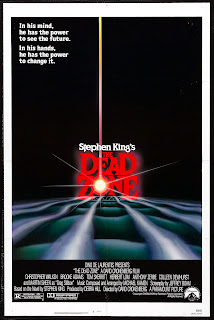
I have been a Stephen King fan for a long time.  However, I discovered him during the 1980s when he was writing epics like The Stand and It .  Of course I knew of the other books before those, and I think I started my King obsession with Pet Sematary , which is still one of my favorite of his earlier, pulp-style horror novels.  I had seen many of the movies based on the older books, but strangely did not dive into most of his '70s output until I was an adult.  An exception to that was The Dead Zone . I don't remember when I first read it, but it has always been one of my favorites of that classic first run of King novels.  Carrie had a certain young rebel style, while 'Salem's Lot was a great horror tale, but The Dead Zone had a complexity to it that foreshadowed many of his later books.  It was as if King had something to prove at this point when it came to writing outside of straight horror.  Director David Cronenberg appears to have approached the m...
House of Wax (1953)

Image
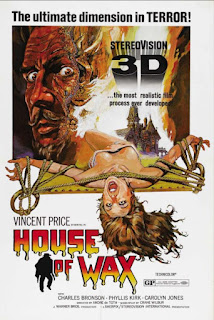
Gimmicks have been around as long as movies have.  There was always a fight to get people to come out to see a film, and 3-D was one of the earliest innovations, being developed in the early 1920s.  It was primitive and headache-inducing, but it was an innovation.  Despite that the usual way of getting butts in the seats - showing as much sex and violence as possible - has always won out.  That hasn't stopped studios from trying it again every few years. In the 1950s movie studios began to feel the pinch from a completely new medium: television.  Television had started to make small steps and a bit of an impact, particularly in Germany and the UK, in the 1930s, but it wasn't until the late 1940s that it started to really catch on in the U.S.A.  Early televisions were expensive and not known for great quality, but that changed going into the 1950s and, faced with the idea that more Americans might just want to so save a few bucks and sit at home around the t...

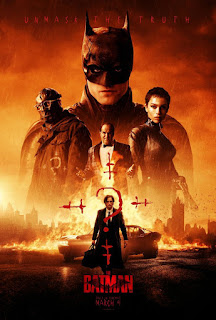
The Batman (2022)

Image
Ever since Christopher Nolan's Dark Night trilogy it seems like every few years we get a new Batman with a new actor in the role.  Typically it's because the previous director screwed it up so badly that, by the time everyone gets around to making the next movie no one involved with the previous movie feels like bothering.  At least that appears to be what happened to Ben Affleck, who was set to reprise his role as the caped crusader and even direct the next Batman film.  He even filmed a new coda to Zach Snyder's Justice League to kind of give a hint to where the story would have gone if Joss Whedon hadn't derailed the series.   A number of factors led to Affleck departing, both as star and director, and Matt Reeves taking over behind the camera.  Though he liked the script that Affleck had planned to film he decided to write his own and completely remove The Batman  from the D.C. Cinematic Universe films before it.  That meant completely avoidi...

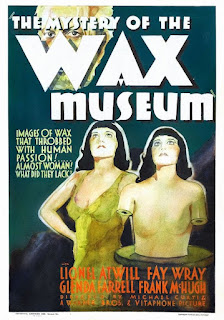
The Mystery of the Wax Museum (1933)

Image
Adding sound to movies wasn't the only innovation in the 1930s.  While the majority of movies were in black and white hand-tinting and other methods of providing color to movies had been around almost from the beginning, going all the way back to George Méliès's A Trip to the Moon .  It was something directors and film companies could do if they wanted, but it was a time-consuming process.  That started to change with the advent of two-strip Technicolor.  Unlike three-strip - which would be used in major movie productions starting later in the decade - the two-strip technique involved combining blue/green and orange/red so that it would give the illusion of numerous colors.  It is a bit strange to modern eyes, as even watching a movie as old as Gone with the Wind or The Wizard of Oz had the three-strip method.  In many ways the two-strip process feels barely a step above black and white. This means it does lend a certain style to to the movies it was used i...

Pumpkinhead 2: Blood Wings (1993)

Image
Despite having a number of flaws, Pumpkinhead has managed to become a minor cult film.  A lot of it had to do with the great creature design, designed by Stan Winston's effects company, as well as a creepy, atmospheric directing style by Winston himself.  The story may be thin and many of the main characters unmemorable, but the film sticks with the viewer afterward. Winston directed another movie - a disastrous flop called A Gnome Named Gnorm  - before returning to effects work when not occasionally making music videos.  Ed Harley, the character Lance Henriksen played in the first movie, died at the end of Pumpkinhead , having committed suicide in order to stop Pumpkinhead's rampage.  Pretty much Stan Winston made what should have been a one-off film without much room for a sequel, even if there were hints that Harley's soul may be used to power Pumpkinhead the next time it is called upon. That fact never seems to keep studios from figuring out a way of making...

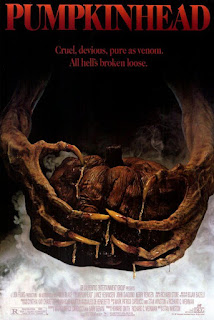
Pumpkinhead (1988)

Image
Stan Winston was one of the major special effects artists in Hollywood.  He provided the creature designs and effects work for The Thing , The Terminator, the first two Jurassic Park films and, shortly before his death, Iron Man .  One of the things he most wanted to do at some point in his career was move from just doing the effects to directing, and that opportunity arose with the script for Pumpkinhead .  He was asked to create the creature design, but instead asked to direct it. As a result, and largely due to Winston knowing what effects could be done on a meagre budget, Winston delivered what has since become a cult hit.  A monster film rather than a straight horror film, Pumpkinhead was lambasted by critics at the time but eventually became a bit more revered for being able to successfully bring such a story to the screen under what would be challenging circumstances for most directors.  In this case he also knew the best thing that he could do is step ba...

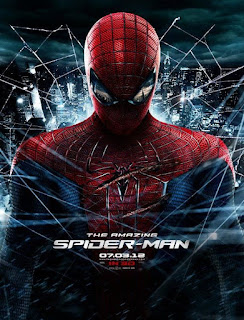
The Amazing Spider-Man (2012)

Image
After releasing what are consider the one of the best and one of the worst superhero films ever made Sam Raimi was ready to take the series in a new direction.  First, he wanted to make up for the problems in Spider-Man 3 , but also introduce new villains and lay out a completely new track for Peter Parker.  After all, by the end of Spider-Man 3 Harry Osborne has been redeemed through self-sacrifice, Mary Jane and Peter are together again and, by letting the Sandman go, Peter has learned to see beyond absolutes of good and evil.  For all its faults it still largely wrapped up the beginning of Peter's journey. Raimi wanted Curt Conners, played by Dylan Baker in a small role as Peter's physics professor, to finally morph into his role as the Lizard, one of the major villains from the comics.  Sony, however, wanted to feature the Vulture, and had plenty of notes for Raimi.  While Raimi's script, and some of the tangents it took, did have a lot to do with why Spider...