Posts

Romancing the Stone (1984)

Image
One of the oldest clichés in Hollywood is a writer or actor trying to get their big break by getting the attention of an well-known actor, director or producer that has just happened into their restaurant.  It pretty much works out the same way as submitting any other unsolicited work, which is being informed of the proper channels.  With actors it's usually so someone can enjoy their lunch in peace.  With a script there are other legal complications involved and few people want to get sued later just because they made a movie with a giant green monster and someone that brought them appetizers just happened to have a giant green monster in the script they left behind.  There are, as in all things, exceptions to the rule, and this exception was Diane Thomas.  She presented her script for Romancing the Stone to actor Michael Douglas and he liked it and decided to produce it.  After going through all the usual steps, Robert Zemeckis was hired as a director and...

The 7th Voyage of Sinbad (1958)

Image
Producer Charles Schneer and stop motion effects expert Ray Harryhausen decided that they had gone as far as they wanted with invasion from space movies after making  20 Million Miles to Earth .  It was time to move on, both technically and literally, to something else.  By this point they had made enough to do color films and, as Harryhausen's skills (and technology itself) improved, to do an effects-filled film like no other.   Still, it wasn't like there was an unlimited budget, so one of the most important things to do was find a property that many people are familiar with and that was not going to cost anything.  In this case, it's the tales of Sinbad the Sailer, a 9th Century adventurer that appeared in later versions of One Thousand and One Nights , first showing up in the 17th century.  The stories, independent of One Thousand and One Nights , tell a seven-voyage cycle of Sinbad often losing his wealth, going to sea, getting shipwrecked and, th...

Raiders of the Lost Ark (1981)

Image
As legend has it George Lucas began to explain the germ of what would become Raiders of the Lost Ark shortly after Star Wars became an unexpected success.  Where Star Wars was his take on the old science fiction serials, Lucas also wanted to make a film based on adventure serials that he remembered as a boy.  Despite the success of Star Wars, Jaws and Close Encounters of the Third Kind, it still took a long time to convince a studio to let them do their movie.  Finally Paramount did so. Next was who was to play Indiana Jones.  Lucas didn't want Harrison Ford, as he was afraid that Ford and himself would become associated the way Martin Scorsese and Robert De Niro have.  The truth was, though, that he was the best fit, and audiences were eager to see more of him.  Star Wars: The Empire Strikes Back had left Han Solo's fate dangling, and at the time that was the role that Ford was known for.  Rather than forever associate him with Lucas the role of Ind...

Saw V (2008)

Image
Darren Lynn Bousman bowed out of the Saw series after Saw IV , so for the first time since the original movie was directed by James Wan and Leigh Whannell someone other than him was in the director's chair. This man was David Hackl, and he had been the production designer for the Saw films that Bousman had helmed.  This fifth entry in the series was his debut film and would also be the one movie that anyone would remember by him.  Unfortunately for Hackl, although it is not as bad as some would make it out to be, this is the nadir of the series. To bring everything up to date, Saw IV's events largely happened along the same timeline, and in the same place, as Saw III .  Agent Peter Strahm (Scott Patterson), while pursuing Jigsaw, stumbles upon Jeff (Angus Macfayden) after Jeff has killed John Kramer (Tobin Bell).  Seeing him as a threat Strahm shoots him, but then finds himself locked in the room with Kramer's body and the rest.  At the same time Agent Rigg (Lyr...

Cloverfield (2008)

Image
In the 1950s the United States was attacked by deadly mantises, giant ants, grasshoppers and just about everything else, up to and including a giant papier mache turkey.  The assault continued into the 1970s, even reaching to the point where it was gigantic, killer rabbits.  The Beast from 20,000 Fathoms gave us our own dinosaur while It Came from Beneath the Sea  gave us an octopus, but these were all one-offs.  Even King Kong, who is supposed to be our giant monster, only managed to visit New York once, and our own attempt to embrace Godzilla in 1998 was something best left forgotten.  There have recently been announcements of a true sequel to Cloverfield, so maybe after all these years we'll get our own giant monster series.  It's going to be a bit confusing since J.J. Abrams and company have already used the Cloverfield name for two other unrelated films, 10 Cloverfield Lane and The Cloverfield Paradox , simply because they hoped they could ride the c...

Gorgo (1961)

Image
Gorgo promises that it is like "nothing you have ever seen before."  The millions who have seen Godzilla , The Beast from 20,000 Fathoms and even The Giant Behemoth  may dispute that fact.  Not surprising, since Gorgo shares something in common with two of those movies: director Eugène Lourié.  His main thing was working on giant monster films, often with effects experts like Ray Harryhausen and Willis H. O'Brien.   This time around instead of stop motion Lourié jumps into suitmation, the style developed by Eiji Tsubaraya to get around the fact that stop motion was expensive and Japan really didn't have an expert in the field.  Instead they made a suit, originally of a cement compound but later a polymer, that an actor would be encased in and then stomp around a bunch of miniature buildings and cars.  When done right it was (and still is) a way of making a convincing monster movie without breaking the bank.  When done badly it ends up being ...

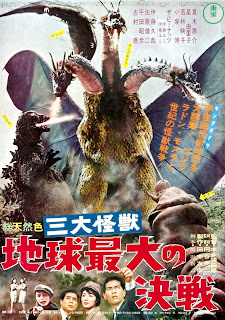
Ghidorah, the Three-Headed Monster (1964)

Image
Akira Kurosawa, Toho's prestige director and one of their big moneymakers, failed to deliver his new film Red Beard for the end of of 1964.  Thus, instead of one Godzilla film, Japan was blessed with two that year.  They also got a bonus: not only was Ghidorah, the Three-Headed Monster a direct sequel to Mothra vs. Godzilla , but it was also a roundabout sequel to 1956's Rodan .  Directed by Ishiro Honda, with Eiji Tsubaraya as usual doing the effects work, Rodan was a step forward in the visual department and was notable for being the first kaiju movie in color.   To bring everything up to speed, Rodan and his mate were giant pterodactyls.  Instead of atomic breath they used their supersonic speed as well as their ability to build up gusts of wind to make a mess of parts of Japan.  In the end, after his mate is killed, the male Rodan flies into a volcano and is presumed dead.  Meanwhile, Godzilla was defeated by the two offspring of Mothra after ...